
The City in pairs
The Binôme principle is incorporated in many aspects of the city. Pairs of all sizes create blocks, neighborhoods, even the entire center itself.

The neighborhood
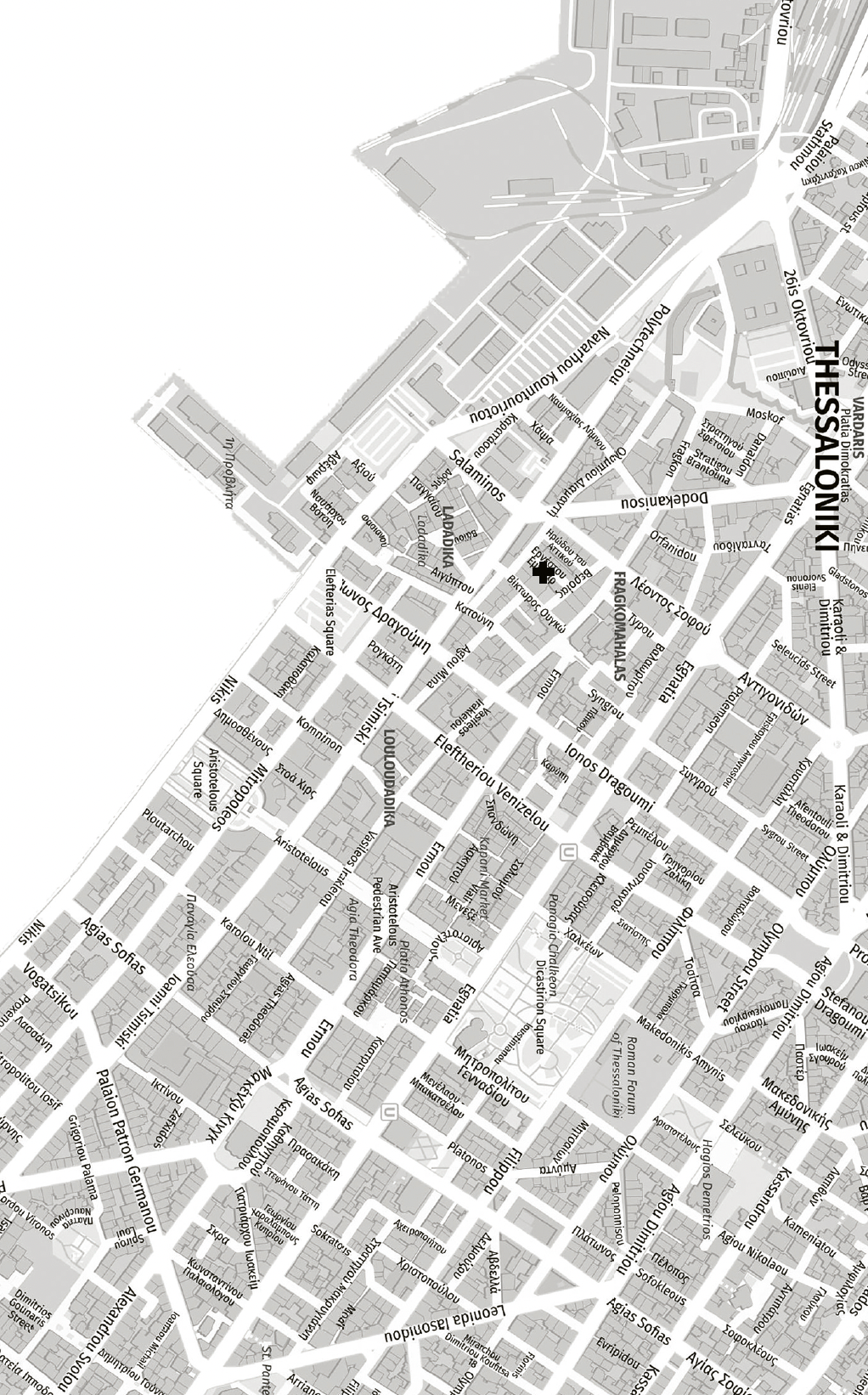
Emprar Street is located in Ano Ladadika (Upper Oil Merchants District). For centuries, its prime location near the port kept it buzzing with activity. After a period of decline, today it has once again come alive with small hubs of creativity and innovative musical and culinary ventures. All it takes is a few steps and a keen sense of smell to figure it out.
Of course, there's also Kato Ladadika (Lower Oil Merchants District), which begins as soon as you cross Polytechniou Street. In between, you'll find meze bars, ethnic restaurants, bars, and clubs—in other words, everything that makes for a lively night out. Somewhere within the narrow streets lies the oldest surviving building in the city. We're sure you'll spot it.
The city
If you can handle the uphill climbs and aren't afraid to walk more than ten thousand steps, Ano Poli (the Upper City) is for you. Two-story houses, cobblestone streets, and staircases that look like a giant version of Snakes and Ladders, along with small cafés and restaurants as old as time itself.
Whether you sit in a wicker chair or on a low bench under a plane tree, relax and let this piece of history speak to you. If you climb high enough, you'll see all of Thessaloniki as an amphitheater, with its waterfront taking center stage.
The city's relationship with the water is almost erotic. Filled with cyclists and pedestrians of all ages, its waterside is flat yet bustling. The stretch in front of the historic center is narrower but lined with cafés and restaurants. The New Waterfront is more spacious, featuring sculptures and themed parks.
The Port defines the first one, while the city's Music Hall defines the second. Between these two stands the White Tower, the landmark that balances the two areas. And of course, every spot along the way offers you the most generous, colorful sunset.
The center
There's a line dividing the city center into two distinct areas.
It has six lanes and is called Egnatia Street.
The part of the city below it is more established: the commercial center, food markets like Modiano or open-air markets such as Kapani and Athonos, large, bustling streets like Tsimiski, and spots teeming with life throughout the day and night, such as Aristotelous Square.
On the upper side, the scenery is more unconventional: cafés, new restaurants, jewelry and ceramics workshops, and, of course, Olympou Street—one of the coolest streets in the world for 2025, according to Time Out magazine.
The gastronomy
The city's food scene won't disappoint you, because it has a test group with uncompromising standards: its own residents. Here, you'll find everything: street food, fancy restaurants, seafood spots, and meat joints. As for the most iconic example of culinary diversity, you don't even have to leave the block. Emprar Street is the place to be.